

Feedback as Entry
Most founders know they need feedback. Few know how to get feedback that actually helps them make decisions.
The Customer Validation Primer — Feedback Lab is a hands-on workshop that closes that gap. It gives founders a practical framework for testing ideas, products, prototypes, and messaging with real customers before investing significant time and resources into building the wrong thing. Participants leave not just with new knowledge but with a specific plan for what to test next, who to talk to, and how to structure the conversation.
The session sits at the earliest stage of the founder journey — before significant investment, before a built product, before a locked-in direction. Its purpose is to make the validation process feel concrete and doable rather than theoretical and intimidating.
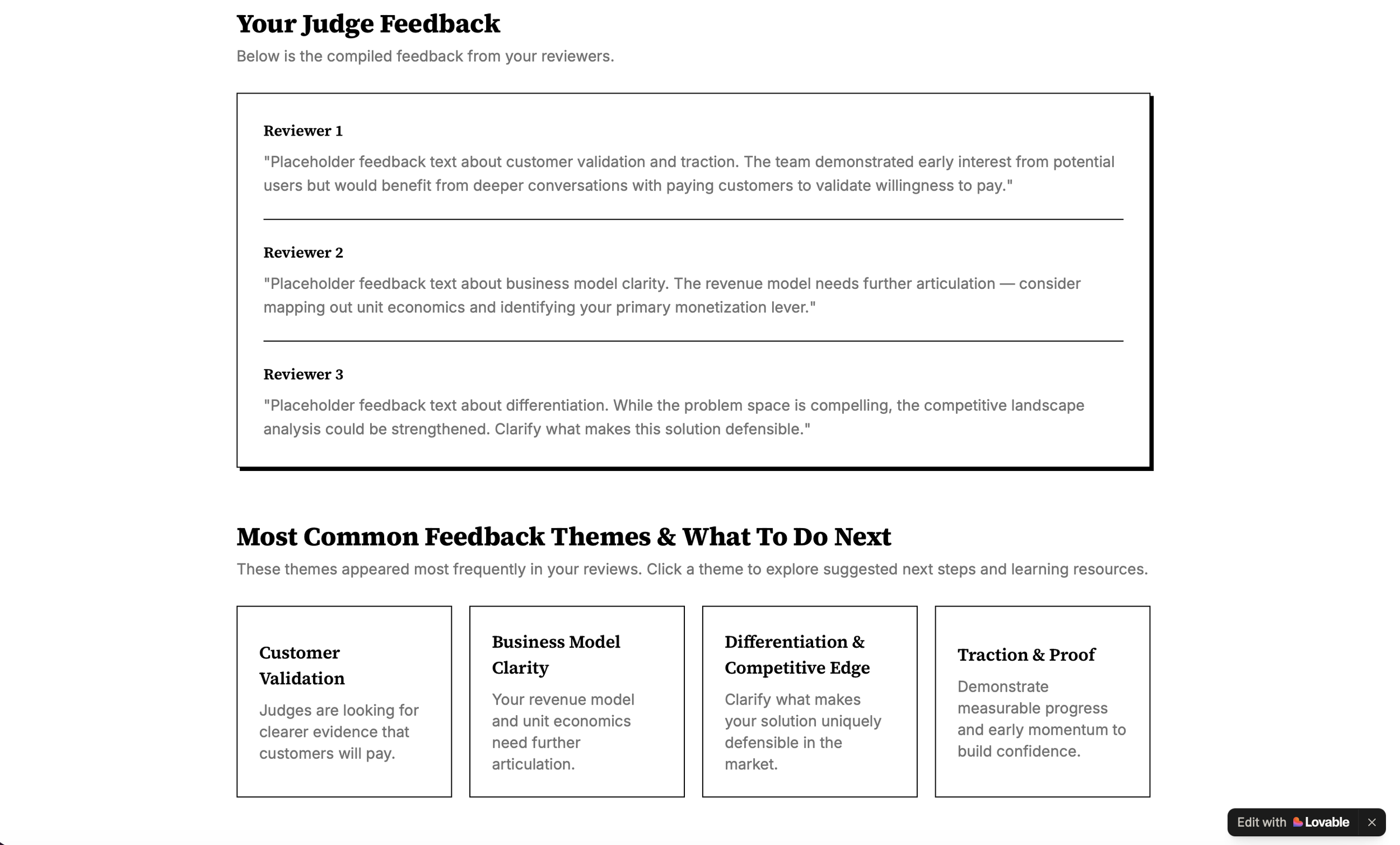
The Problem It Solves
Founders at the idea and early-build stage consistently make the same mistakes when seeking input on their work. They ask questions designed to confirm what they already believe. They talk to people who are too polite to challenge them. They interpret enthusiasm as evidence. They walk away from a dozen conversations with no clearer picture of whether their idea is worth pursuing.
The result is wasted time, false confidence, and a pattern of building things that customers didn't actually need — discovered only after significant investment.
This workshop intervenes at the moment before that pattern takes hold. It reframes the goal of a customer conversation from seeking approval to seeking evidence — and gives founders the specific tools to tell the difference.
What It Is
A structured workshop combining instruction, worked examples, and interactive exercises. Hands-on throughout. Participants work on their own ventures in real time, not hypothetical case studies.
Participants will learn:
The difference between feedback and validation — and why it matters
When and how to seek customer input at different stages
How to ask questions that surface honest, useful responses
How to recognize and avoid the most common feedback traps
How to turn a set of conversations into a concrete next step
Participants will leave with:
A Feedback Planning Worksheet specific to their venture
A Feedback Conversation Guide with questions they can use immediately
A Validation Tracker for organizing and making sense of what they hear
A specific validation question to explore in the week after the workshop
The Founder Journey
1 — Discovery
Founders learn about the workshop through the i-lab newsletter, Slack, advisor recommendations, or community outreach.
The question they're asking:Can this workshop help me figure out whether my idea, product, or message is actually working?
2 — Registration and Preparation
Founders sign up and reflect on what they want to bring into the room. This might be a business idea still in concept form, an early prototype, a landing page, a value proposition they can't quite articulate, or a pitch they're not sure is landing.
The goal: Arrive with a specific challenge rather than a general desire for input. The more specific the question a founder brings in, the more useful the session becomes.
3 — Workshop — The Learning Layer
Participants explore the conceptual foundations of good validation practice:
What validation actually means — and how it differs from collecting opinions
The types of feedback that inform decisions versus the types that just feel good
The most common mistakes founders make when seeking customer input
How to design a feedback conversation that surfaces honest, useful signal
How to recognize an insight worth acting on
The goal: Shift from "I need feedback" to "I need to learn something specific — and here is how I find it."
4 — Workshop — The Practice Layer
Participants apply what they've learned through interactive exercises:
Reviewing real feedback scenarios and identifying what's signal and what's noise
Practicing customer questions on each other and noticing what works
Evaluating their own assumptions and identifying which ones carry the most risk
Spotting validation opportunities in their current stage of work
The goal: Build confidence using feedback frameworks in a low-stakes environment before taking them into real customer conversations.
5 — Validation Planning
Before leaving the workshop, each participant builds a concrete validation plan for their own venture:
What are they testing?
Who should they talk to?
What questions should they ask?
What does a useful answer look like?
The goal: Leave with a next step that is specific enough to act on in the next week — not a general intention to "talk to more customers."
6 — Independent Validation
After the workshop, participants go apply what they learned with real people:
Customer conversations
Prototype walkthroughs
Message testing
Outreach experiments
Lightweight assumption tests
The goal: Move from understanding the framework to generating real evidence about their own venture.
7 — Reflection and Iteration
Participants return to what they heard and make sense of it:
What feedback was most useful and why?
Which assumptions held? Which ones shifted?
What do they still need to learn?
The goal: Use evidence — not instinct, not enthusiasm, not a single encouraging conversation — to decide what to do next.
Workshop Topics
Understanding Validation
The difference between feedback and validation. The difference between opinions and evidence. How assumptions create risk. How to set a learning goal before a customer conversation begins.
Asking Better Questions
How to structure open-ended questions that surface honest responses. How to avoid leading questions that confirm what you already believe. How to listen for behavioral signal rather than stated preference.
Common Feedback Mistakes
Seeking affirmation instead of learning. Talking more than listening. Asking hypothetical questions that produce hypothetical answers. Interviewing the wrong audience. Interpreting a polite response as a positive one.
Turning Feedback Into Action
How to identify patterns across multiple conversations. How to prioritize insights when they point in different directions. How to decide what to test next. How to avoid over-rotating on a single conversation.
Resources and Artifacts
Every participant leaves with three tools designed for immediate use:
Feedback Planning Worksheet A structured pre-conversation planning document.
What are you testing?
Why does it matter?
Who should you talk to?
What assumptions are most at risk?
Feedback Conversation Guide A practical in-conversation reference.
What problem are you trying to solve?
How are people solving it today?
What questions should you ask?
What signals are you looking for?
Validation Tracker A simple log for organizing what you hear across multiple conversations.
Person interviewed
Feedback received
Key insights
Assumptions challenged
Next actions
What Success Looks Like
Quantitative Signals
Registrations and attendance rate
Resource downloads and post-session engagement
Return attendance at follow-on programs (Customer Discovery OOH, Discovery Sprint)
Qualitative Signals
Founders arriving at Customer Discovery Office Hours with a specific validation question rather than a general one
Participants reporting clearer next steps in follow-up outreach
Stronger, more specific customer discovery work visible in subsequent advising conversations
The Core Transformation
This workshop targets a specific before-and-after shift:
Before the workshop:
"I need feedback on my idea."
After the workshop:
"I know what I need to learn, who I need to talk to, and how to gather evidence that helps me make better decisions."
The distance between those two statements is not just knowledge — it is confidence, specificity, and a concrete plan. That is what the Feedback Lab is designed to produce.
How It Fits the Broader Pathway
The Customer Validation Primer is an entry point, not a standalone intervention. It sits at the beginning of the i-lab's customer discovery pathway and is designed to connect forward:
javaCopy code
Customer Validation Primer (Feedback Lab) ↓ Customer Discovery Office Hours ↓ Customer Discovery Sprint ↓ MVP Feedback Session
A founder who completes the Primer and applies it independently is ready for the structured accountability of the Sprint. A founder who skips the Primer and goes straight to the Sprint often struggles with the basics the Primer would have covered. The sequencing matters.
Harvard Innovation Labs · Program Design Documentation
